
English
Quick links
Reading
“Reading for pleasure is the single biggest factor in success later in life, outside of an education. Study after study has shown that those children who read for pleasure are the ones who are most likely to fulfil their ambitions. If your child reads, they will succeed – it’s that simple.” Bali Rai
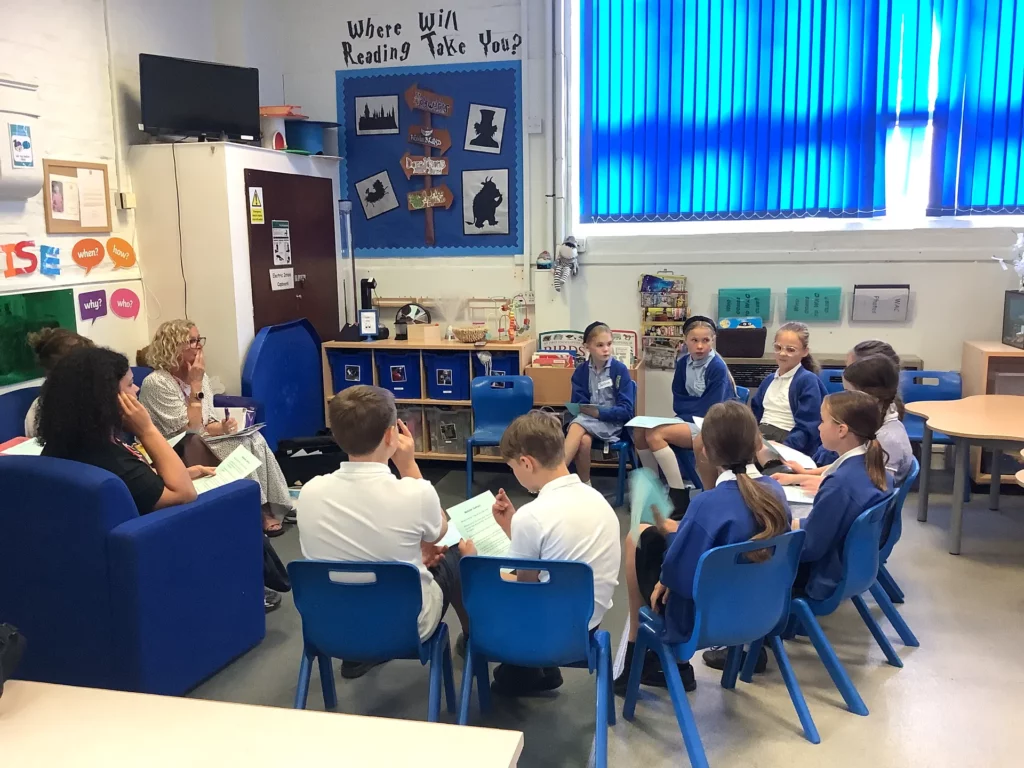
At Exning Primary School, we foster a love of reading because we understand the importance that reading plays in developing children’s confidence and in allowing them full access to the wider curriculum. We want to ensure our pupils are ready for the next stage of their education and provide them with crucial skills and knowledge which will aid their future success.
Writing
At Exning Primary School, we teach writing using a variety of strategies to inspire children’s work.
We take many principles from the Talk for Writing philosophy, as laid out by Pie Corbett, but combine these with techniques and ideas from the Power of Reading philosophy. We also use Jane Considine’s The Write Stuff for our longer pieces of fiction writing across the school, which focuses on vocabulary and the use of textual convention. Children use drama and text-interrogation techniques, as well as spending time unpicking the technical features of the text type and investigating language and structure. With all of these tools and techniques at their disposal, children are able to use high-level, quality literacy texts to inspire high quality writing.
Children are encouraged to edit their work by “Purple Polishing” and redrafting, using a range of tools to support them in their work. We use a range of peer, teacher and self-marking where children use structured marking ladders and success to assess their work.
Assessment is both formative and summative, with children being given a combination of written and verbal feedback to inform their improvements and next steps. Teachers will assess children’s writing against the objectives of the National Curriculum and use these to inform their planning for each written topic.
Spelling and grammar
Spelling
Spelling is taught discretely throughout the whole school, using resources from EdShed’s Spelling Shed. Please see long term plans for details of which specific spelling patterns and rules are taught in each phase.
Word lists, games and practise ideas are sent home with children to complete at home and are linked to the word-types, patterns and rules that they have been learning that week. Some children need additional support with spelling and they work in intervention groups to fill gaps, many caused by COVID interruptions. Children may also engage in specific literacy interventions (e.g. Morph Mastery) if phonetic approaches to spelling have not worked for them.
Grammar
In Key Stage 2 (Years 3-6), we teach whole-class Grammar sessions in-line with the National Curriculum. Please see long-term plans for exact coverage of each phase.
Grammar will be taught discretely a minimum of 3 times per week and will be revisited during Do It Now tasks and Talk Tasks at the beginning of lessons. Some English lessons will have a grammar focus when teaching writing skills, particularly when looking at advanced punctuation, which impacts on the meaning of sentences. Children in year 6 will revise concepts from all previous year groups, as well as learning new grammar and punctuation as specified by the National Curriculum. Children will have a termly grammar assessment, which will allow teachers to focus their teaching sequences on the needs of each specific class.
Phonics
Little Wandle is our chosen phonics programme.
At Exning Primary school, we believe that all our children can become fluent readers and writers. This is why we teach reading through Little Wandle Letters and Sounds Revised, which is a systematic synthetic phonics programme.
We start teaching Little Wandle Foundations from Reception, we follow the Little Wandle Letters and Sounds Revised progression, which ensures children build on their growing knowledge of the alphabetic code, mastering phonics to read and spell as they move through school. As a result, all our children are able to tackle any unfamiliar words as they read.
At Exning, we also model the application of the alphabetic code through phonics in shared reading and writing, both inside and outside of the phonics lesson and across the curriculum. We have a strong focus on language development for our children because we know that speaking and listening are crucial skills for reading and writing in all subjects.
Comprehension
At Exning, we value reading as a crucial life skill. By the time children leave us, they read confidently for meaning and regularly enjoy reading for pleasure. Our readers are equipped with the tools to tackle unfamiliar vocabulary. We encourage our children to see themselves as readers for both pleasure and purpose.
Because we believe teaching every child to read is so important, we have a Reading Leader who drives the early reading programme in our school. This person is highly skilled in teaching phonics and reading, and they monitor and support our reading team, so everyone teaches with fidelity to the Little Wandle Letters and Sounds Revised programme.
How we teach phonics and Early Reading (Early Years and KS1) at Exning.
- In reception and Y1, children follow the progression within Little Wandle Letters and Sounds Revised programme. Phonics is taught daily and there is a review session on a Friday.
- Phonics starts in reception in week 2 to ensure the children make a strong start, alongside Foundation for Phonics games and songs.
- By the end of reception, children will have been taught up to the end of phase 4.
- By the end of year 1, children will have been taught up to the end of phase 5.
- Children in year 2 recap any gaps in their phonics knowledge in the autumn term.
Reading practise sessions:
- Children across reception, year 1, year 2 (and beyond if appropriate) apply their phonics knowledge by using a full matched decodable reader in a small group reading practice session.
- These sessions are 15 minutes long and happen three times a week. There are approximately 6 children in a group, and the session is run by a fully trained adult within our staff team.
- The sessions follow the model set out in Little Wandle Letters and Sounds Revised and focus on three key reading skills: decoding, prosody and comprehension.
- The children then have the same book allocated the following week to ensure success is shared with the family.
- In reception these sessions start in week 4. Children who are not yet blending use a Wordless Book
How do we assess phonic knowledge?
Children who do not meet standard in the Phonics Screening Check in Y1, will complete this in Y2. Support continues to be put in place for these children.ort. Where further support is required, 1:1 interventions are used where needed. These interventions are short, specific and effective.
In reception, year 1 and year 2 at the end of each week there is a review session which recaps the learning. There are also whole review weeks (pre-planned and bespoke review weeks to address gaps identified by the class teacher’s ongoing formative assessment).
Children identified in reception, year 1 and year 2 as in danger of falling behind are immediately identified and daily ‘keep up’ sessions are put in place – these sessions follow the Little Wandle Letters and Sounds Revised programme.
In reception and year 1, the children are assessed at the end of every half term using the Little Wandle Letters and Sounds Revised assessment tracker.
Children in year 1 complete the statutory Phonics Screening Check in the summer term.
At the beginning of each academic year, we will hold an information session for parents and carers to find out more about what we do for Phonics, Reading and English at our schools. Please do join us.